解析力学から様々な理論分野を組み立てる 第1部 第4章 §1.4.5 ★★ 降下時間の汎関数も独立変数を含まない。第一積分 y ( 1 + y ′ 2 ) = 一定 y(1+y'^2)=\text{一定} y ( 1 + y ′2 ) = 一定
降下時間の汎関数
鉛直な平面の中で、原点から静かに放した玉が、摩擦なしに曲線 y ( x ) y(x) y ( x ) ( X , Y ) (X,Y) ( X , Y ) y y y 下向き にとる。重力加速度を g g g v = 2 g y v=\sqrt{2gy} v = 2 g y d s = 1 + y ′ 2 d x \mathrm{d} s=\sqrt{1+y'^2}\,\mathrm{d} x d s = 1 + y ′2 d x v v v d s / v \mathrm{d} s/v d s / v
T [ y ] = ∫ 0 X 1 + y ′ 2 2 g y d x , y ( 0 ) = 0 , y ( X ) = Y (1.4.16) \mathcal T[y]=\int_0^X\frac{\sqrt{1+y'^2}}{\sqrt{2gy}}\,\mathrm{d} x,\qquad y(0)=0,\quad y(X)=Y\tag{1.4.16} T [ y ] = ∫ 0 X 2 g y 1 + y ′2 d x , y ( 0 ) = 0 , y ( X ) = Y ( 1.4.16 )
である。被積分関数は x = 0 x=0 x = 0 y = 0 y=0 y = 0 y y y x x x 1 / 2 1/2 1/2 0 0 0 y = ( Y / X ) x y=(Y/X)x y = ( Y / X ) x
第一積分からサイクロイドへ
L = 1 + y ′ 2 / 2 g y L=\sqrt{1+y'^2}/\sqrt{2gy} L = 1 + y ′2 / 2 g y x x x
y ′ ∂ L ∂ y ′ − L = y ′ 2 2 g y 1 + y ′ 2 − 1 + y ′ 2 2 g y = − 1 2 g y 1 + y ′ 2 . y'\frac{\partial L}{\partial y'}-L=\frac{y'^2}{\sqrt{2gy}\sqrt{1+y'^2}}-\frac{\sqrt{1+y'^2}}{\sqrt{2gy}}=-\frac{1}{\sqrt{2gy}\sqrt{1+y'^2}} . y ′ ∂ y ′ ∂ L − L = 2 g y 1 + y ′2 y ′2 − 2 g y 1 + y ′2 = − 2 g y 1 + y ′2 1 .
この値を − 1 / 4 g r -1/\sqrt{4gr} − 1/ 4 g r r > 0 r>0 r > 0
y ( 1 + y ′ 2 ) = 2 r (1.4.17) y\,(1+y'^2)=2r\tag{1.4.17} y ( 1 + y ′2 ) = 2 r ( 1.4.17 )
を得る。この1階の方程式は、傾き y ′ y' y ′ y ′ = cot ( θ / 2 ) y'=\cot(\theta/2) y ′ = cot ( θ /2 ) 0 < θ < 2 π 0<\theta<2\pi 0 < θ < 2 π 1 + y ′ 2 = 1 / sin 2 ( θ / 2 ) 1+y'^2=1/\sin^2(\theta/2) 1 + y ′2 = 1/ sin 2 ( θ /2 )
y = 2 r sin 2 θ 2 = r ( 1 − cos θ ) . y=2r\sin^2\frac\theta2=r(1-\cos\theta). y = 2 r sin 2 2 θ = r ( 1 − cos θ ) .
x x x d x = d y / y ′ \mathrm{d} x=\mathrm{d} y/y' d x = d y / y ′ d y = r sin θ d θ = 2 r sin θ 2 cos θ 2 d θ \mathrm{d} y=r\sin\theta\,\mathrm{d}\theta=2r\sin\frac\theta2\cos\frac\theta2\,\mathrm{d}\theta d y = r sin θ d θ = 2 r sin 2 θ cos 2 θ d θ cot ( θ / 2 ) \cot(\theta/2) cot ( θ /2 ) d x = 2 r sin 2 θ 2 d θ = r ( 1 − cos θ ) d θ \mathrm{d} x=2r\sin^2\frac\theta2\,\mathrm{d}\theta=r(1-\cos\theta)\,\mathrm{d}\theta d x = 2 r sin 2 2 θ d θ = r ( 1 − cos θ ) d θ x ( 0 ) = 0 x(0)=0 x ( 0 ) = 0
x = r ( θ − sin θ ) , y = r ( 1 − cos θ ) (1.4.18) x=r(\theta-\sin\theta),\qquad y=r(1-\cos\theta)\tag{1.4.18} x = r ( θ − sin θ ) , y = r ( 1 − cos θ ) ( 1.4.18 )
を得る。これは半径 r r r x x x サイクロイド と呼ぶ。θ = 0 \theta=0 θ = 0 y ′ = cot 0 y'=\cot0 y ′ = cot 0
時間も径数で書ける。線素は d s = d x 2 + d y 2 = r ( 1 − cos θ ) 2 + sin 2 θ d θ = 2 r sin θ 2 d θ \mathrm{d} s=\sqrt{\mathrm{d} x^2+\mathrm{d} y^2}=r\sqrt{(1-\cos\theta)^2+\sin^2\theta}\,\mathrm{d}\theta=2r\sin\frac\theta2\,\mathrm{d}\theta d s = d x 2 + d y 2 = r ( 1 − cos θ ) 2 + sin 2 θ d θ = 2 r sin 2 θ d θ v = 2 g r ( 1 − cos θ ) = 2 g r sin θ 2 v=\sqrt{2gr(1-\cos\theta)}=2\sqrt{gr}\sin\frac\theta2 v = 2 g r ( 1 − cos θ ) = 2 g r sin 2 θ d s / v = r / g d θ \mathrm{d} s/v=\sqrt{r/g}\,\mathrm{d}\theta d s / v = r / g d θ
T = θ B r g (1.4.19) \mathcal T=\theta_{\mathrm B}\sqrt{\frac rg}\tag{1.4.19} T = θ B g r ( 1.4.19 )
である。θ B \theta_{\mathrm B} θ B ( X , Y ) (X,Y) ( X , Y ) r r r θ B \theta_{\mathrm B} θ B X = r ( θ B − sin θ B ) X=r(\theta_{\mathrm B}-\sin\theta_{\mathrm B}) X = r ( θ B − sin θ B ) Y = r ( 1 − cos θ B ) Y=r(1-\cos\theta_{\mathrm B}) Y = r ( 1 − cos θ B ) X / Y = ( θ B − sin θ B ) / ( 1 − cos θ B ) X/Y=(\theta_{\mathrm B}-\sin\theta_{\mathrm B})/(1-\cos\theta_{\mathrm B}) X / Y = ( θ B − sin θ B ) / ( 1 − cos θ B ) θ B \theta_{\mathrm B} θ B θ B \theta_{\mathrm B} θ B X / Y > π / 2 X/Y>\pi/2 X / Y > π /2 θ B > π \theta_{\mathrm B}>\pi θ B > π
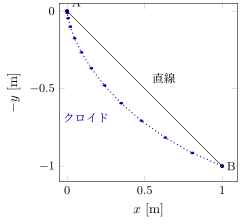
図 1.4.3 原点 A から 1 m 1\,\mathrm{m} 1 m 1 m 1\,\mathrm{m} 1 m y y y T ≈ 0.583 s \mathcal T\approx0.583\,\mathrm{s} T ≈ 0.583 s T ≈ 0.639 s \mathcal T\approx0.639\,\mathrm{s} T ≈ 0.639 s
例題 1.4.5 サイクロイドと直線の降下時間を比べる ★★
オリジナル g = 9.81 m s − 2 g=9.81\,\mathrm{m\,s^{-2}} g = 9.81 m s − 2 ( X , Y ) = ( 1 m , 1 m ) (X,Y)=(1\,\mathrm{m},1\,\mathrm{m}) ( X , Y ) = ( 1 m , 1 m )
(1) 直線 y = x y=x y = x (2) サイクロイドの径数 θ B \theta_{\mathrm B} θ B r r r (1.4.19) を計算せよ。(3) 直線の時間を汎関数 (1.4.16) の積分として計算し、(1) と一致することを確かめよ。
解答 (1) 直線の長さは ℓ = 2 m \ell=\sqrt2\,\mathrm m ℓ = 2 m 45 ∘ 45^\circ 4 5 ∘ g sin 45 ∘ = g / 2 g\sin45^\circ=g/\sqrt2 g sin 4 5 ∘ = g / 2 ℓ = 1 2 ( g / 2 ) T 2 \ell=\frac12(g/\sqrt2)\mathcal T^2 ℓ = 2 1 ( g / 2 ) T 2
T 直線 = 2 2 ℓ g = 4 9.81 s ≈ 0.639 s . \mathcal T_{\text{直線}}=\sqrt{\frac{2\sqrt2\,\ell}{g}}=\sqrt{\frac{4}{9.81}}\,\mathrm s\approx0.639\,\mathrm s . T 直線 = g 2 2 ℓ = 9.81 4 s ≈ 0.639 s .
(2) X / Y = 1 X/Y=1 X / Y = 1 ( θ B − sin θ B ) / ( 1 − cos θ B ) = 1 (\theta_{\mathrm B}-\sin\theta_{\mathrm B})/(1-\cos\theta_{\mathrm B})=1 ( θ B − sin θ B ) / ( 1 − cos θ B ) = 1 θ B ≈ 2.412 \theta_{\mathrm B}\approx2.412 θ B ≈ 2.412 < π <\pi < π r = Y / ( 1 − cos θ B ) ≈ 0.5729 m r=Y/(1-\cos\theta_{\mathrm B})\approx0.5729\,\mathrm m r = Y / ( 1 − cos θ B ) ≈ 0.5729 m
T サイクロイド = θ B r / g ≈ 2.412 × 0.5729 / 9.81 s ≈ 0.583 s . \mathcal T_{\text{サイクロイド}}=\theta_{\mathrm B}\sqrt{r/g}\approx2.412\times\sqrt{0.5729/9.81}\,\mathrm s\approx0.583\,\mathrm s . T サイクロイド = θ B r / g ≈ 2.412 × 0.5729/9.81 s ≈ 0.583 s .
直線より約 9 % 9\% 9%
(3) y = x y=x y = x y ′ = 1 y'=1 y ′ = 1
T = ∫ 0 1 2 2 g x d x = 1 g ∫ 0 1 x − 1 / 2 d x = 2 g ≈ 0.639 s \mathcal T=\int_0^1\frac{\sqrt2}{\sqrt{2gx}}\,\mathrm{d} x=\frac{1}{\sqrt g}\int_0^1x^{-1/2}\,\mathrm{d} x=\frac{2}{\sqrt g}\approx0.639\,\mathrm s T = ∫ 0 1 2 g x 2 d x = g 1 ∫ 0 1 x − 1/2 d x = g 2 ≈ 0.639 s
で、(1) と一致する。x = 0 x=0 x = 0 x − 1 / 2 x^{-1/2} x − 1/2
AI(Claude)が書いた教材を、木下が勉強しながら公開しています。式と数値は検算していますが、誤りが残っているかもしれません。誤りのご指摘・削除のご依頼をいただければ直します。 連絡先:support@tecktom.com